
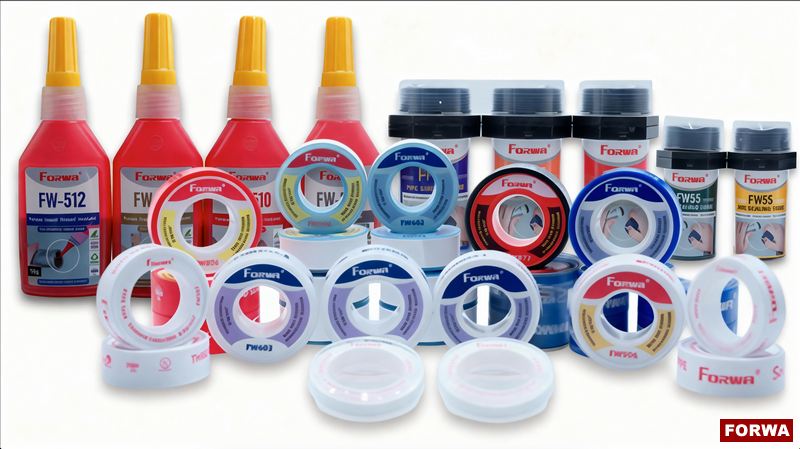
Entering May 2026, the domestic polytetrafluoroethylene (PTFE) thread seal tape industry, under the multiple effects of policy regulation, international supervision, and market demand, has shown a structural differentiation trend of "continuous expansion of high-end production capacity and accelerated clearing of low-end production capacity." The implementation effects of the new national standard and green manufacturing guidelines continue to appear, and combined with the rise in overseas market access thresholds, the entire industry is accelerating its transformation toward a high-quality development stage.
I. National standard upgrading continues to deepen, and industry thresholds are further raised. The national standard "Polytetrafluoroethylene Thread Seal Tape for Pipeline Sealing" (GB/T 1192-2025), revised and issued by the State Administration for Market Regulation, has been profoundly reshaping the industry competition pattern since it came into effect in April 2025. Compared with the old 2013 version, the new standard substantially raises the minimum longitudinal tensile strength limit from 12.0MPa to 15.6MPa, raises the qualification line for strength retention rate after thermal aging from 65% to 78.3%, and adds a mandatory helium mass spectrometry leak detection leakage rate test item. From January 1, 2026, enterprises that do not meet the standards have been prohibited from using the national standard compliance mark for market promotion and bidding. This policy red line directly promoted the rapid increase in industry concentration. At the same time, the "Guidelines for Green Manufacturing Evaluation of Sealing Materials (Trial)" jointly issued by the Ministry of Industry and Information Technology and the Ministry of Ecology and Environment was fully implemented in July 2025, requiring enterprises to have a comprehensive fluorine resin recovery rate of no less than 92.5%, VOCs emission concentration ≤35mg/m³, and comprehensive energy consumption per ton of product ≤1.82 tons of standard coal. Entering 2026, environmental protection departments in many places have increased on-site verification of downstream fluorochemical enterprises. Some small and medium-sized thread seal tape manufacturers are facing production restriction and rectification due to substandard environmental protection facilities, further compressing the living space of low-end production capacity.
II. International regulation is tightening, and export enterprises are under pressure to upgrade. In the international market, on May 12, SKF, a global giant in bearings and sealing solutions, announced that starting from July 2026, it will implement 100% batch testing on elastomer and PTFE seals procured from China, focusing on verifying dimensional stability and compression set performance. This move is regarded as a comprehensive tightening of quality control on China's precision sealing supply chain in the high-end industrial field, and it also imposes stricter requirements on domestic thread seal tape enterprises entering the international high-end supporting system. The European market also sent an important signal. On May 21, the European Sealing Association (ESA) issued a formal statement on the PFAS (per- and polyfluoroalkyl substances) restriction proposal, pointing out that fluoropolymers such as PTFE, FEP, and PFA have irreplaceable characteristics in industrial sealing applications, including high-temperature resistance, chemical inertness, long service life, and ultra-low pollution. A one-size-fits-all restriction would cause major economic impact on key industries such as chemicals, pharmaceuticals, and semiconductors. At present, the EU PFAS restriction consultation has entered a key stage, and the final ruling is expected to distinguish between industrial-grade sealing uses and civilian disposable products. Domestic export-oriented thread seal tape enterprises need to closely monitor subsequent regulatory trends and plan compliance responses in advance.
III. Market size grows steadily, with notable structural optimization characteristics. According to the latest data from industry research institutions, in 2025, domestic sales of PTFE thread seal tape in China reached 1.843 billion yuan, a year-on-year increase of 6.9%, and it is expected to reach 1.971 billion yuan in 2026, with growth basically flat compared with the previous year, but the trend of product structure optimization is very obvious. From the demand side, ultra-clean thread seal tape for semiconductor equipment has become the fastest-growing segmented field, with demand increasing by 41.2% year-on-year in 2025, and its share of total consumption rising to 8.3%; procurement of thread seal tape for primary circuit sealing in nuclear power plants increased by 29.6% year-on-year, and the domestic substitution rate has exceeded 94%. At the same time, demand for traditional chemical pipeline flange sealing declined slightly, reflecting that the industry is transforming from general industrial consumables to high-end strategic basic materials. On the supply side, as of the end of 2025, there were 37 large-scale thread seal tape manufacturers nationwide, with total industry capacity of 126,000 tons/year and capacity utilization of 72.8%. CR5 (market share of the top five enterprises) has risen from 38.6% in 2024 to 45.2%. Leading enterprises such as Zhejiang Juhua and Shandong Dongyue continue to expand their leading advantages through electronic-grade production line layout and nuclear power field certification. It is worth noting that the continuous tightening of upstream R22 production quotas has led to a 4.7% year-on-year increase in PTFE resin procurement costs, forcing leading enterprises to accelerate R&D of fluorine resource closed-loop recovery technology. The pace of the industry's overall evolution toward green, low-carbon, and circular economy is accelerating.