
I. Core Properties
1. Extraordinary chemical inertness
Resistant to almost all strong acids, strong bases, organic solvents, and oxidants (except a very few media such as molten alkali metals and high-temperature fluorine gas).
Widely used in chemical equipment linings and reactor seals.
2. Extremely low coefficient of friction
Coefficient of friction (0.04–0.1) is close to that of ice and is one of the lowest among known solid materials.
Used as oil-free bearings, guide rail coatings, and non-stick pan coatings (such as Teflon®).
3. Wide temperature resistance
Long-term use: -200°C to +260°C (short-term resistance up to 300°C).
Suitable for aerospace and ultra-low-temperature laboratory equipment.
4. Excellent dielectric properties
Low dielectric constant (2.0), low loss, and stable insulation under high-frequency environments.
Used in 5G base station high-frequency circuit boards and special cable insulation layers.
5. Water- and oil-repellent properties (anti-adhesion)
Extremely low surface energy, making it difficult for contaminants to adhere.
Medical catheter coatings (reducing thrombus adhesion) and anti-stick components for food machinery.
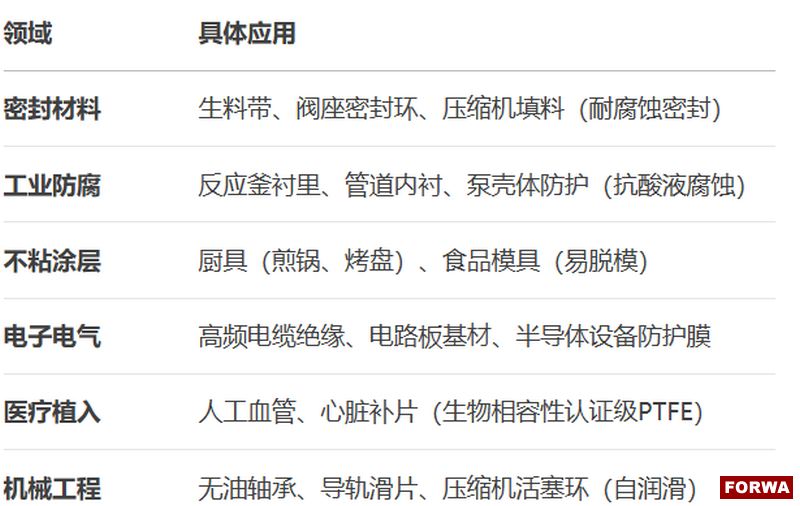
II. Common Applications
III. Limitations (Caution Required in Use)
1. Cold flow (creep)
Easily deforms slowly under long-term stress → reinforced structures must be designed (such as adding metal skeletons to seals).
2. Poor wear resistance
Relatively low hardness (Shore D50–65) → fillers (fiberglass, graphite) need to be added for high-wear applications.
3. High processing difficulty
High melting point (327°C) and extremely high melt viscosity → can only use powder sintering or ram extrusion molding.
4. Radiation sensitivity
Easily degrades after γ-ray or electron beam irradiation → must be carefully selected in nuclear facilities.